 Foundation Musick's Monument
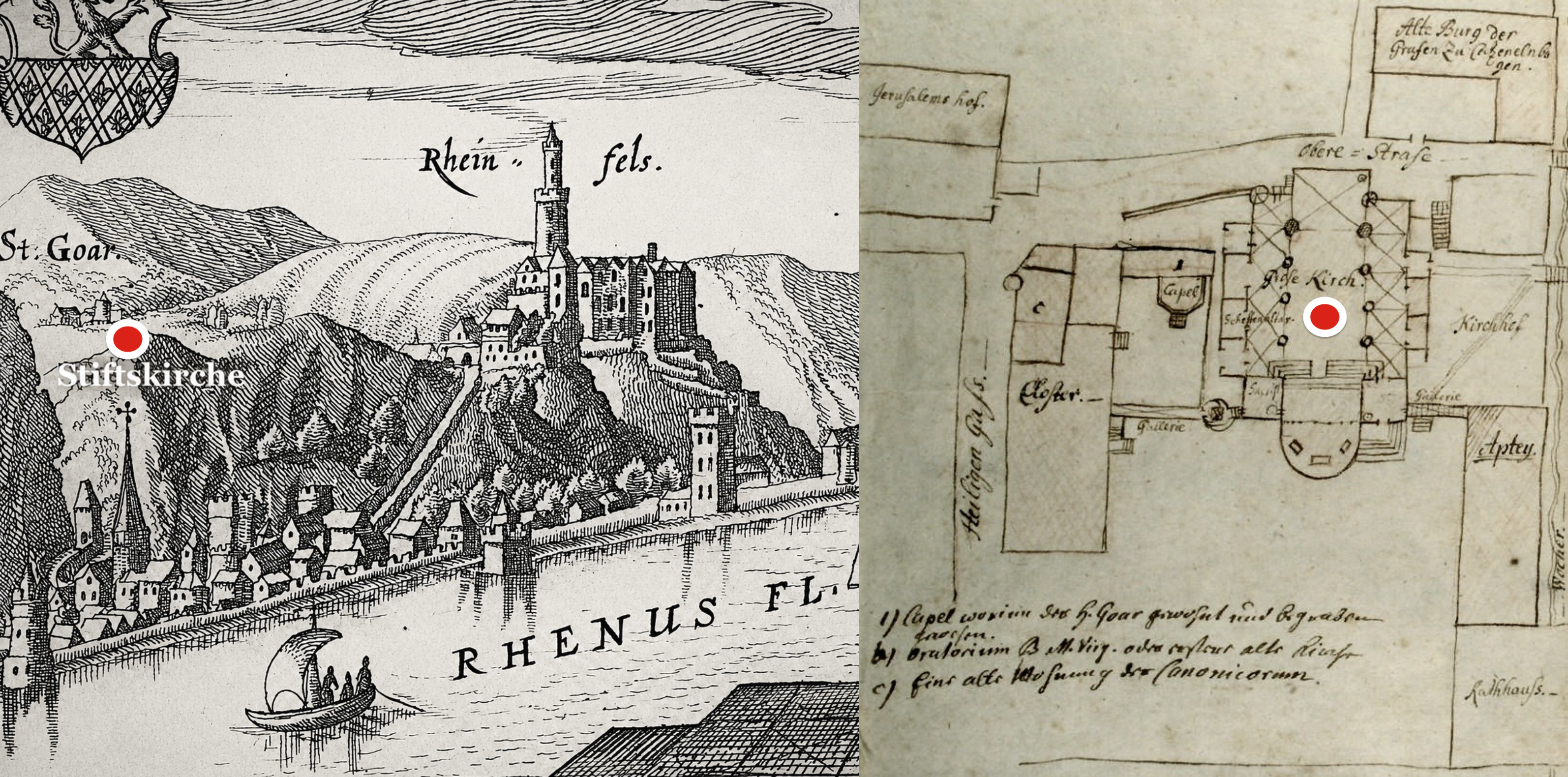
STIFTSKIRCHE ST. GOAR - info
Johann Conrad Knöpfel - Sankt Goar
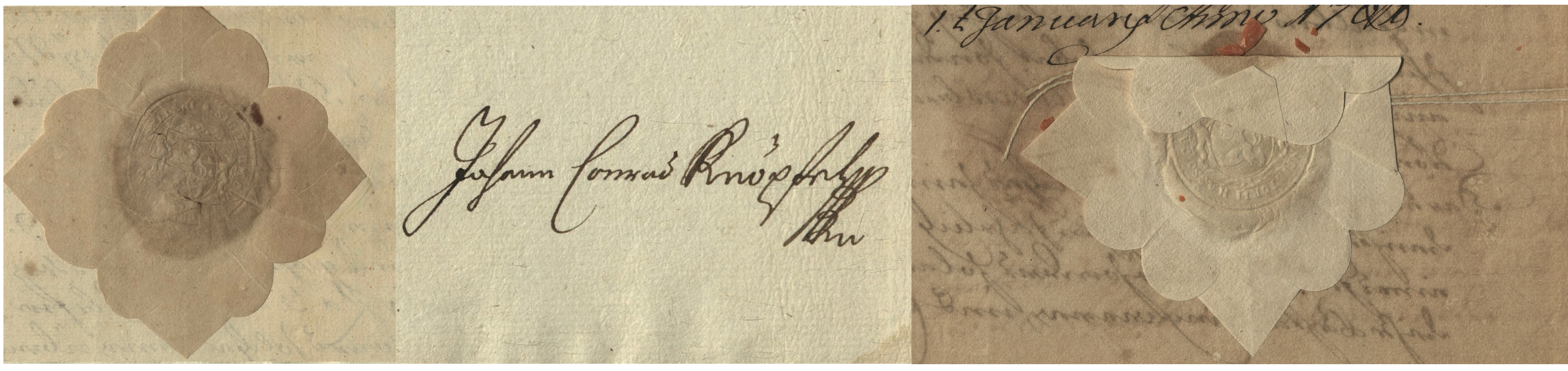
To understand the world in which Susanna Maria Knöpfel grew up in 1706, we must look at the life and work of her father: Johann Konrad Knöpfel (1662–ca. 1720). As the son of a Protestant pastor, Johann Konrad was blessed with a sharp mind and a solid social network. In 1680, he enrolled at the University of Marburg, the intellectual and theological heart of Protestant Hesse. Armed with this academic background, he settled in the strategic Rhine town of Sankt Goar. Here, he built an impressive career that would make him one of the most influential citizens of the region.
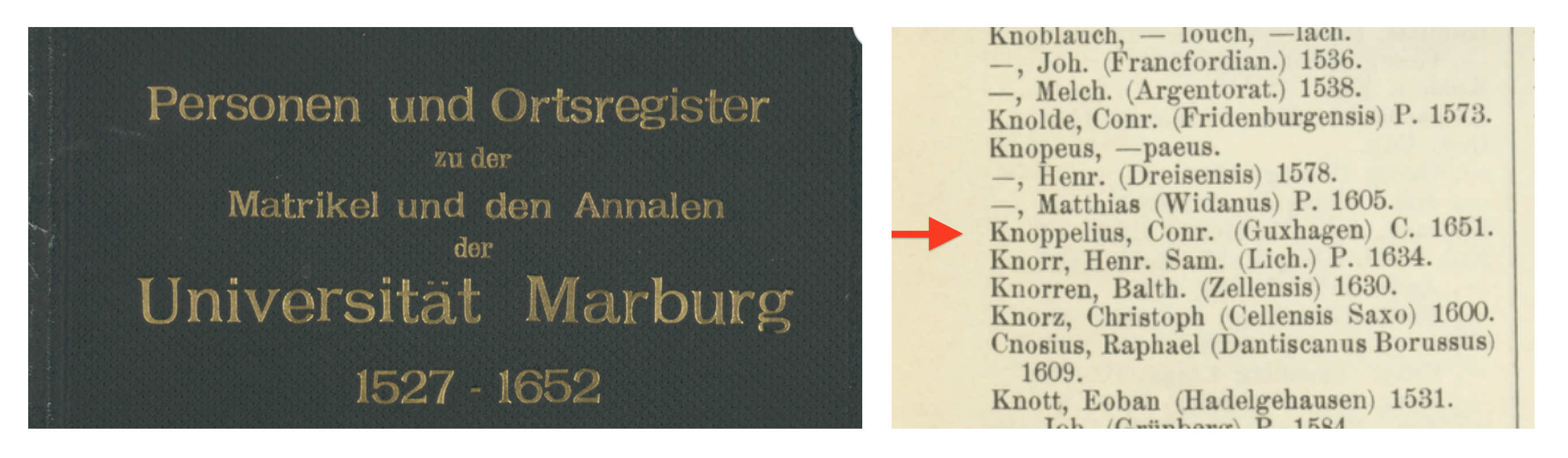
Conrad Knöpfels, Metropolitani zu Milsungen 1651
A Protestant Key Figure Under Catholic Rulers
The political and religious situation in which Johann Konrad had to operate was highly complex. Sankt Goar and the massive Rheinfels Castle towering above it were historically Protestant territories. However, due to an inheritance within the princely house of Hesse, actual power fell into the hands of a strictly Catholic branch in 1693: the House of Hesse-Wanfried. First under Landgrave Charles (1693–1711) and from 1711 under his devout son Landgrave William II, Catholic rulers governed an almost entirely Protestant population.
Although this seemed like a recipe for religious warfare on paper, the practical reality was surprisingly pragmatic. Thanks to old treaties (such as the Regensburger Rezeß), the rights and properties of the Protestants were legally protected. The Catholic landgraves were allowed to practice their faith in the castle chapel on the fortress and in a new church built outside the town walls, but they had to leave the Protestant citizens in peace. To keep the region stable and secure tax revenues, the Catholic landgraves desperately needed reliable Protestant administrators who held the trust of the local people. Johann Konrad Knöpfel was the perfect man at the perfect place.
The Dual Role: Church Finances and Military Logistics
Johann Konrad held a crucial dual role in Sankt Goar. First, he was the Stift-Kellner (administrative manager/cellarer) of the Protestant Stiftskirche. In this influential position, he managed the administration, the extensive lands, and the tax revenues of the Protestant church chapter. The fact that a Catholic landgrave like William II left the control of this vital Protestant financial stream entirely to Knöpfel proves how deeply his integrity and business expertise were respected.
His second function carried even greater responsibility: Johann Konrad was also the Proviant-Commissair (provisions commissioner) of Rheinfels Castle. At the time, Rheinfels was one of the mightiest and most important military fortresses along the Rhine, built to withstand the constant threat of French invasions. As provisions commissioner, Knöpfel was responsible for the massive logistical operation inside the fort. He ensured that military supplies—from grain, meat, and beer to ammunition and gunpowder—were always sufficient to withstand a siege of several months. In an era of constant threat of war, this was an absolute position of trust. Landgrave William II knew that the survival of his strategic castle literally depended on the logistical precision of his Protestant commissioner.
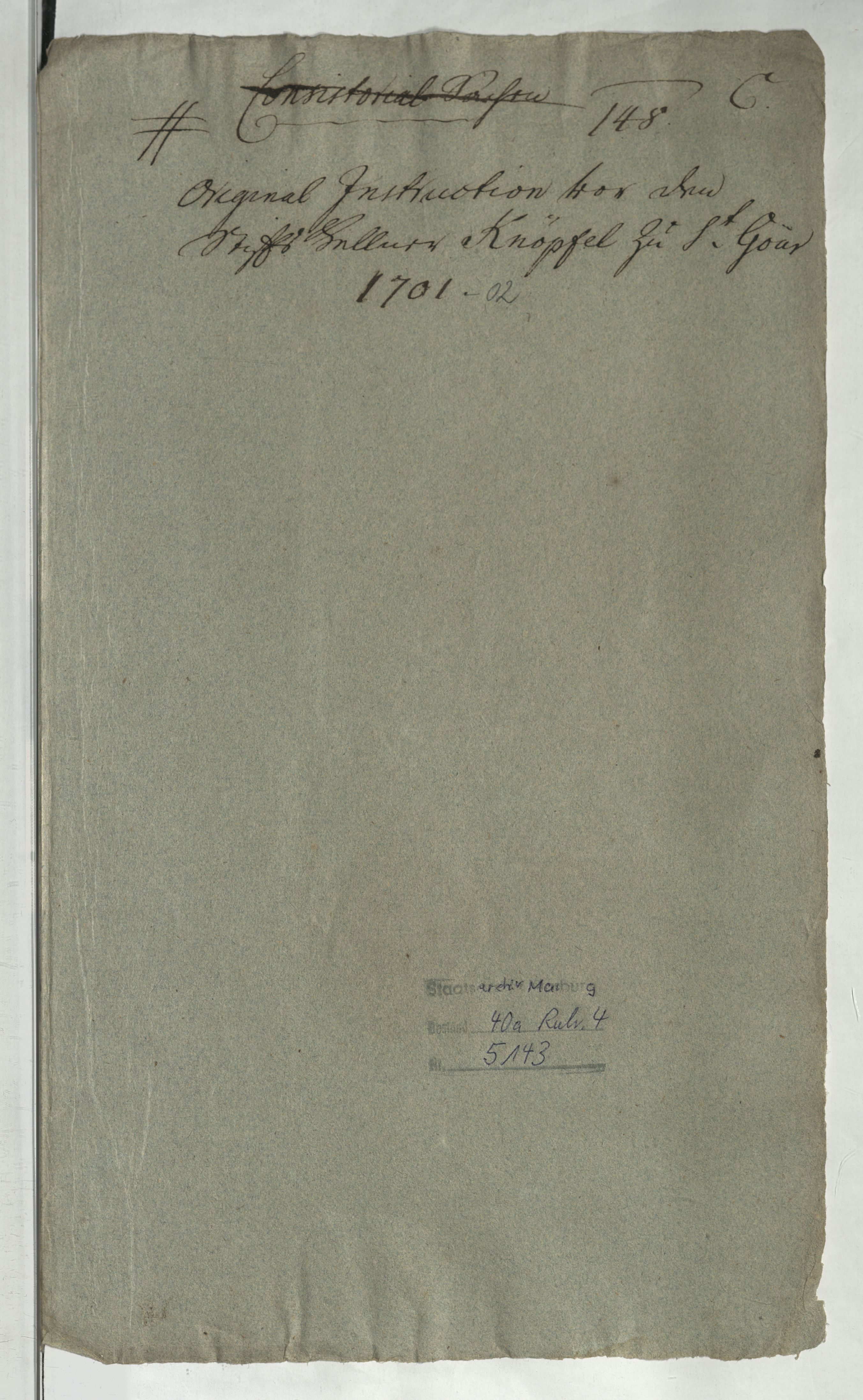
Hessisches Landesarchiv complete files
🇩🇪
Consistorial-Sachen Nr. 148 C.
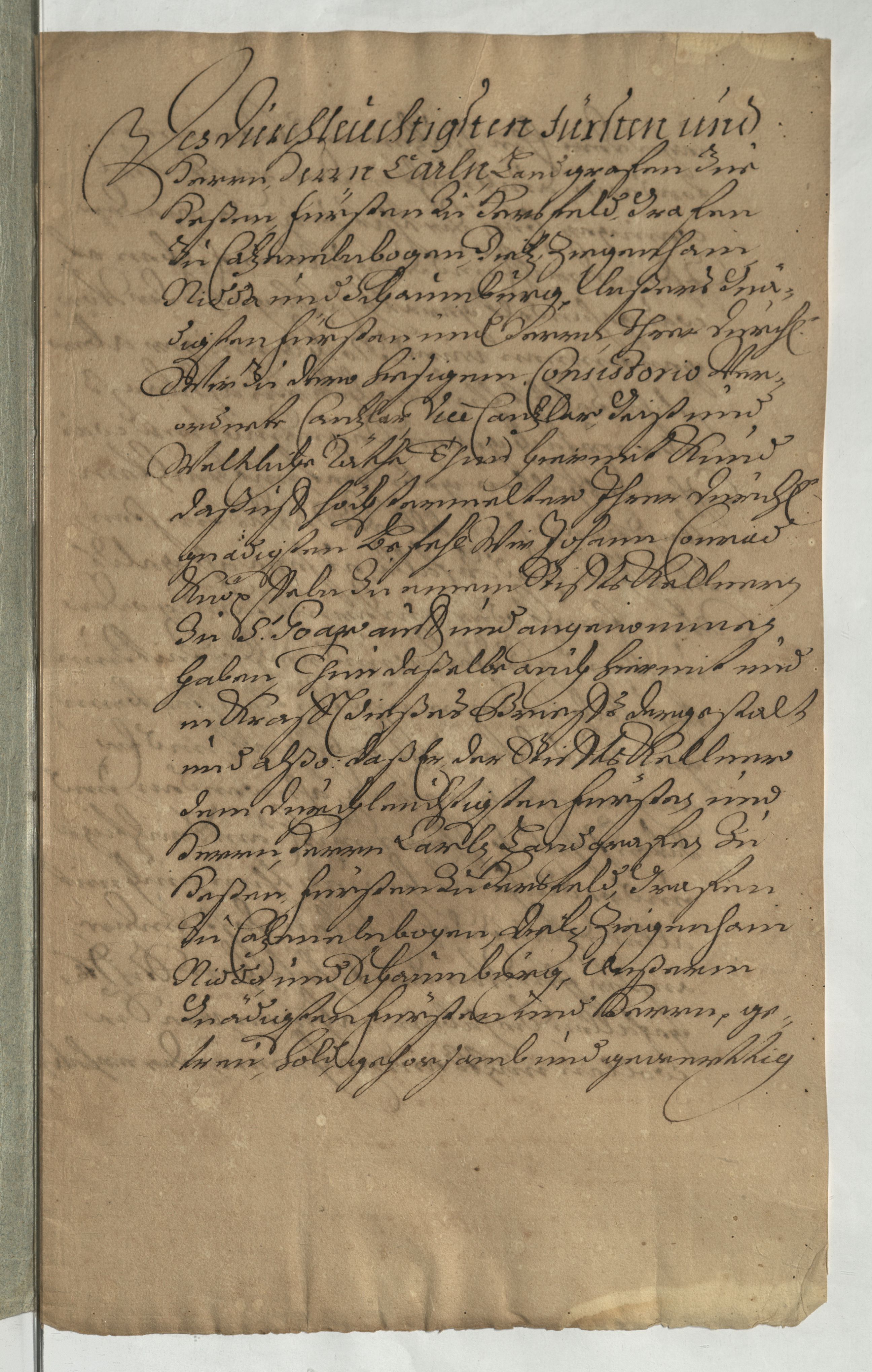
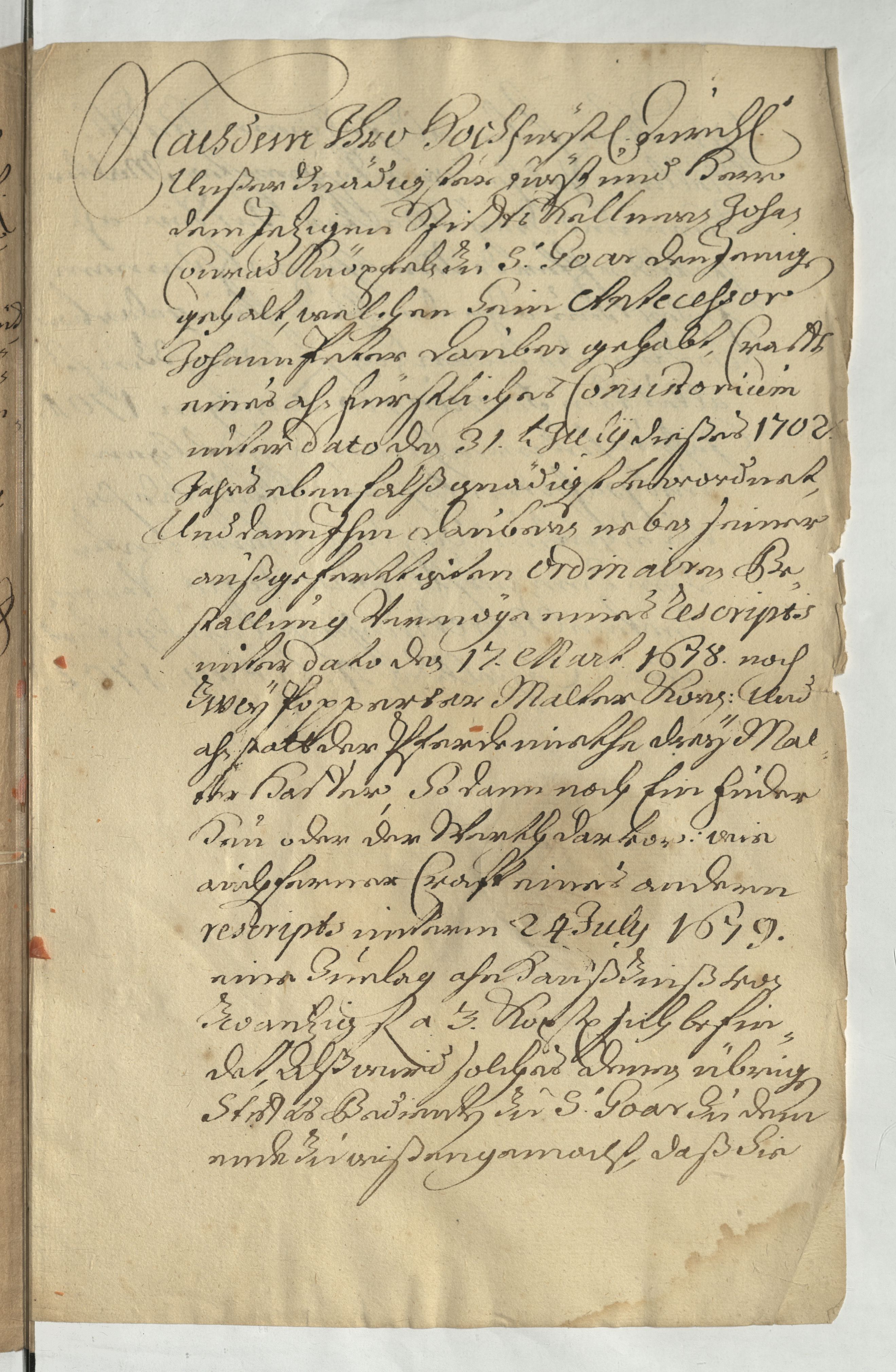
Original-Instruktion für den Stiftskellner Knöpfel zu St. Goar (1701–1702).
1701–02. (Archiefstempel/nota: Staatsarchiv Marburg, Best. 40a Rubr. 4 Nr. 5143)
🇬🇧
Consistory Affairs No. 148 C.
Original instructions for the Church Foundation Cellarer (Stiftskellner) Knöpfel at St. Goar (1701–1702).
🇬🇧
We, by the Grace of God, Charles, Landgrave of Hesse, Prince of Hersfeld, Count of Katzenelnbogen, Diez, Ziegenhain, Nidda, and Schaumburg, hereby make known:
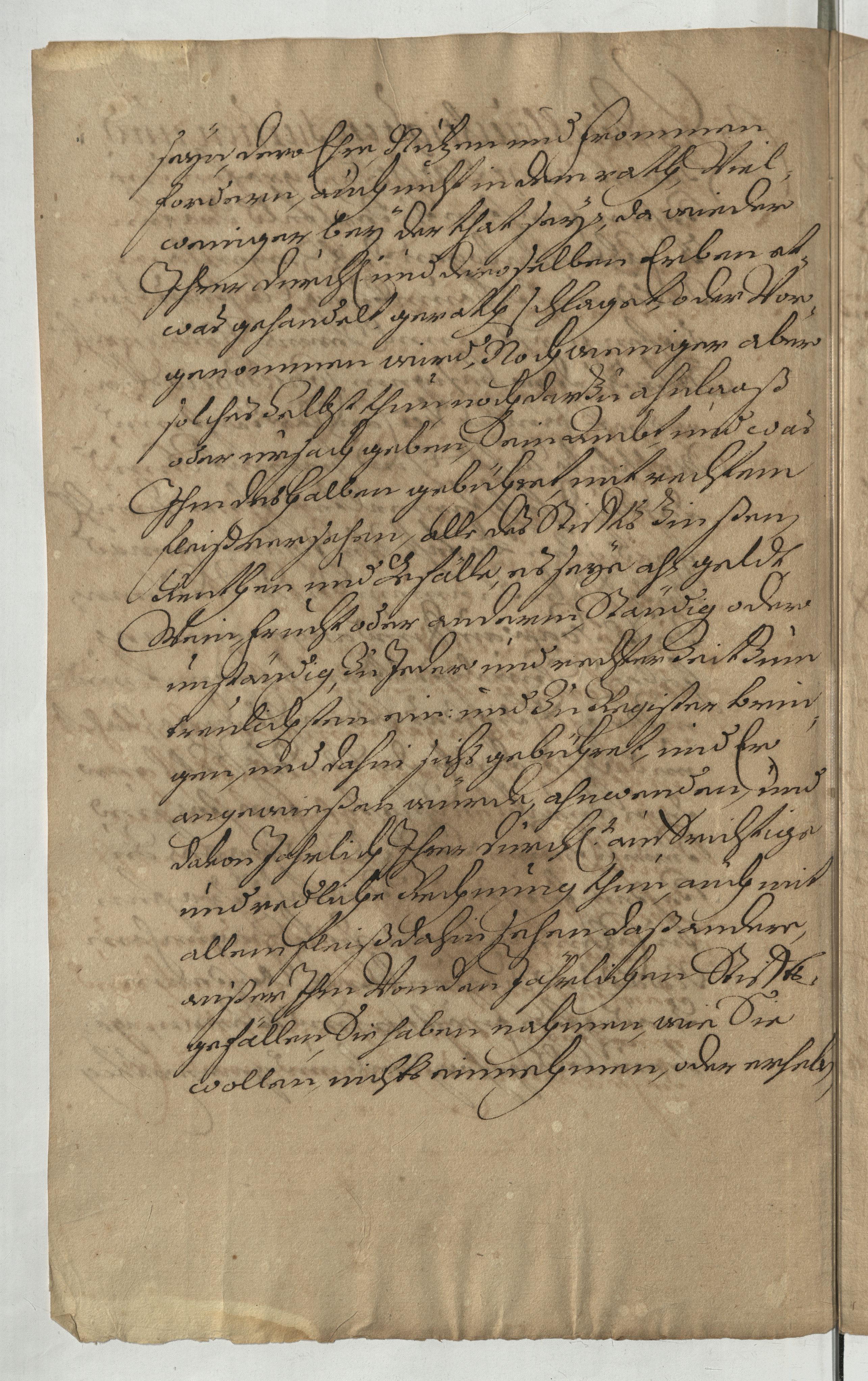
By princely decree, our appointed Consistory officers (Chancellor, Vice-Chancellor, and Councillors) have accepted and appointed Johann Conrad Knöpfel to our Foundation at St. Goar. By virtue of this document, we grant him the office of Foundation Cellarer (Stiftskellner). He shall remain faithful, loyal, and obedient to the most serene Prince and Lord Charles.
🇬🇧
He must prevent any harm to the Prince, report potential risks, and dutifully collect, register, and account for all revenue of the foundation (whether in money, wine, grain, or other dues) in a timely manner. He is required to submit an annual account of the foundation's finances.
🇬🇧
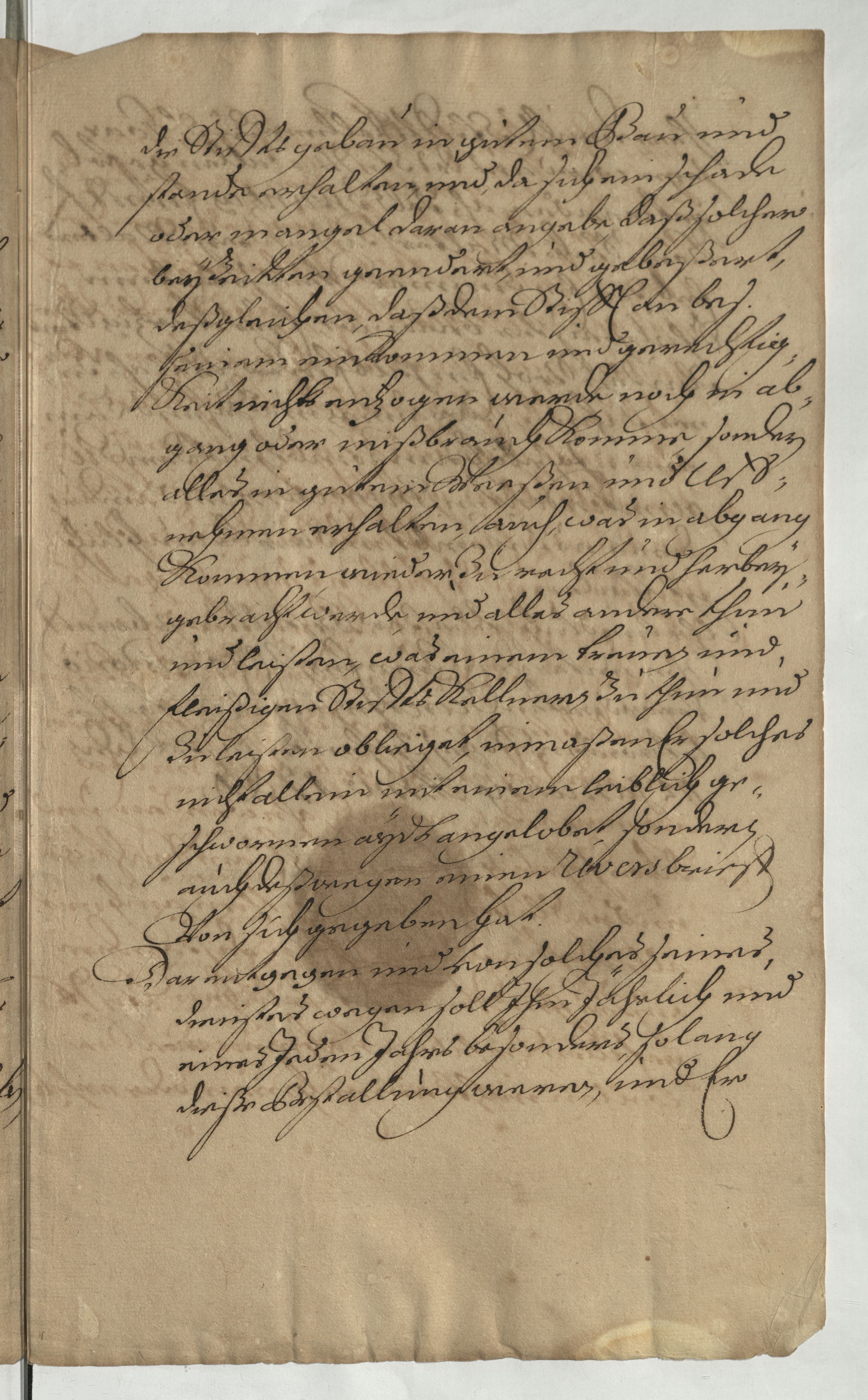
Furthermore, he must maintain the foundation's buildings in good condition and promptly report and repair any defects or damages. He shall ensure that no rights or revenues of the foundation are lost or abused. He has pledged this through a personal oath and a written bond (Reversbrief).
🇬🇧
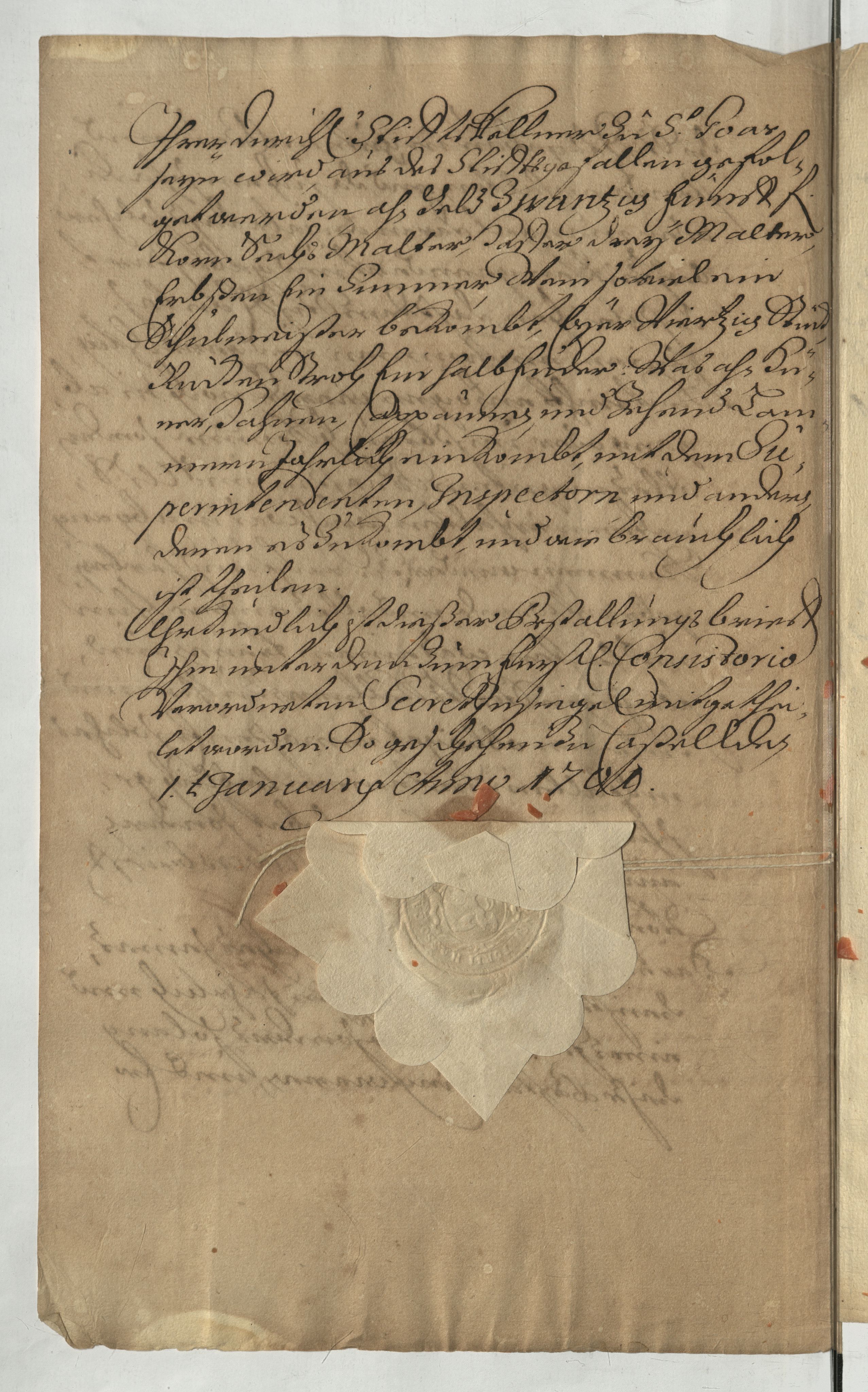
In return for his service, he shall receive the following annual compensation from the foundation’s revenues:
Monetary: 5 Reichstalers
Grain: 6 malters of corn, 3 malters of barley, 1 sommer of peas
In-kind: Wine (equal to the schoolmaster's allowance), bread for personal use, wax, coal, and timber allowances.
Given at Kassel, January 1, 1701, under the official seal of the Consistory.
🇬🇧
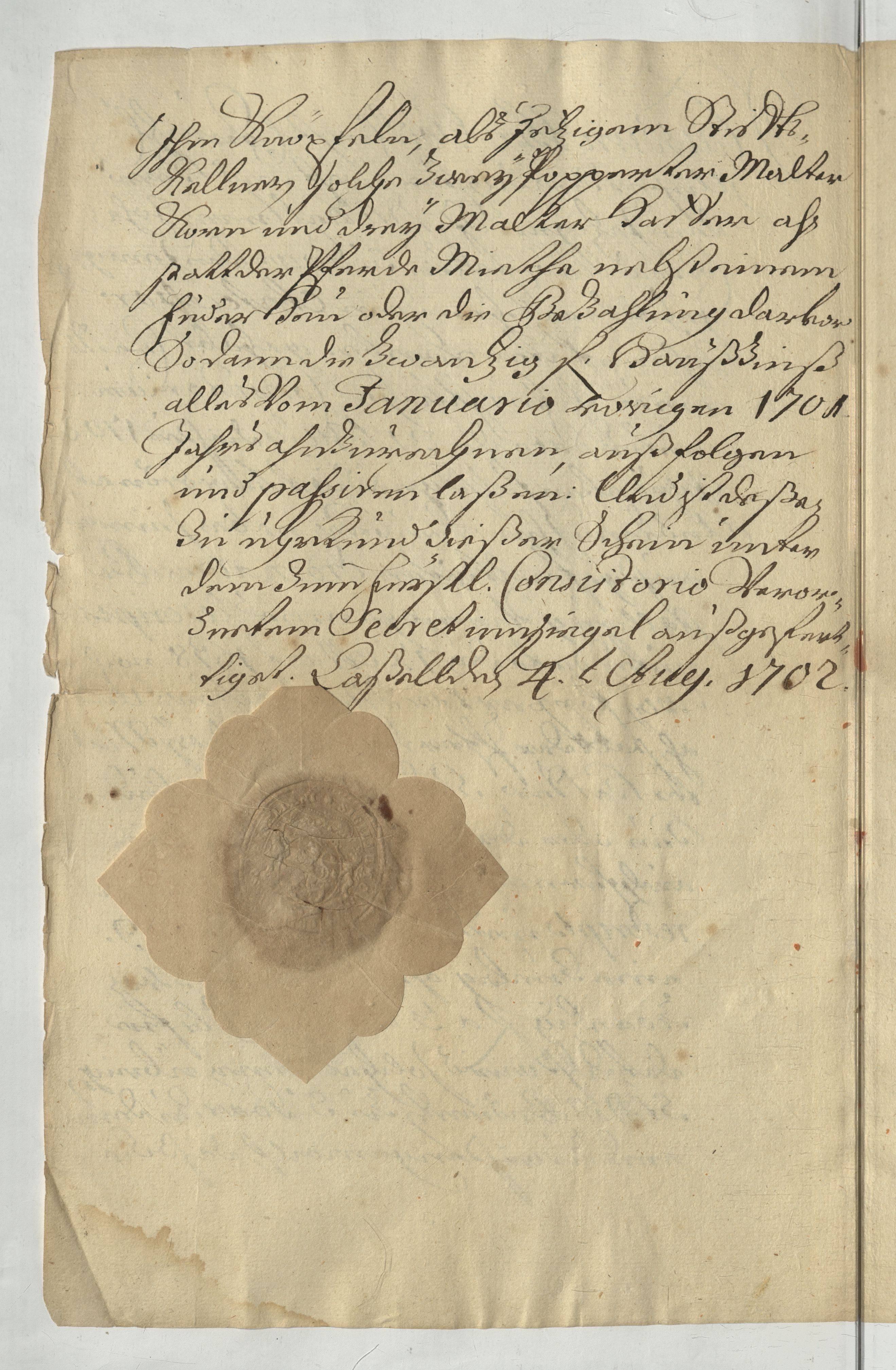
Addendum (Rescript of July 31, 1702):
The Landgrave decrees that Johann Conrad Knöpfel shall receive the exact same salary as his predecessor, Johann Peter Treiber. In addition, pursuant to earlier rescripts (from 1678 and 1679), he is granted additional provisions: 3 sechster-malters of corn, 3 malters of wheat (replacing prebendal wine), and monetary allowances for poultry (chickens/geese) and shipping tolls amounting to 20 Reichstalers and 3 Albus.
🇬🇧
To him, as the current Foundation Cellarer (Stiftskellner), the aforementioned 3 sechster-malters of corn and 3 malters of barley (in lieu of the prebendal wine), together with one fuder of corn (or its monetary equivalent), as well as the 20 Reichstalers for the shipping toll, are to be granted, paid out, and approved retroactively from January of the preceding year 1701.
In witness whereof, this document has been issued under the seal of the Princely Consistory. Given at Kassel, July 4, 1702.
Stability in a Respected Family
While Johann Konrad navigated daily between the interests of the Protestant citizenry down in the town and the Catholic court up at the castle, he built his own family life. On April 29, 1695, he married Regina Magdalena Dirx in the Stiftskirche (a daughter from a solid, local-regional Protestant background).
In this wealthy, highly educated, and well-respected family of the Stift-Kellner, their daughter Susanna Maria Knöpfel was baptized on September 11, 1706. She grew up in a world where culture, religious tolerance, administrative responsibility, and music went hand in hand. It was this specific, intellectual Protestant upbringing in the shadow of Rheinfels Castle that laid the foundation for her later life and her marriage in 1733 to the gifted pastor's son and harpsichord maker Johann Daniel Dulcken.
The son of Conrad Knöpfel, born in Wolfershausen in 1662 and enrolled at the University of Marburg in 1680, became quartermaster at the Hessian fortress of Rheinfels near St. Goar.
Conrad Knöpfel married Regina Magdalena Dirx on 29 April 1695. Conrad Knöpfel died before 1721.
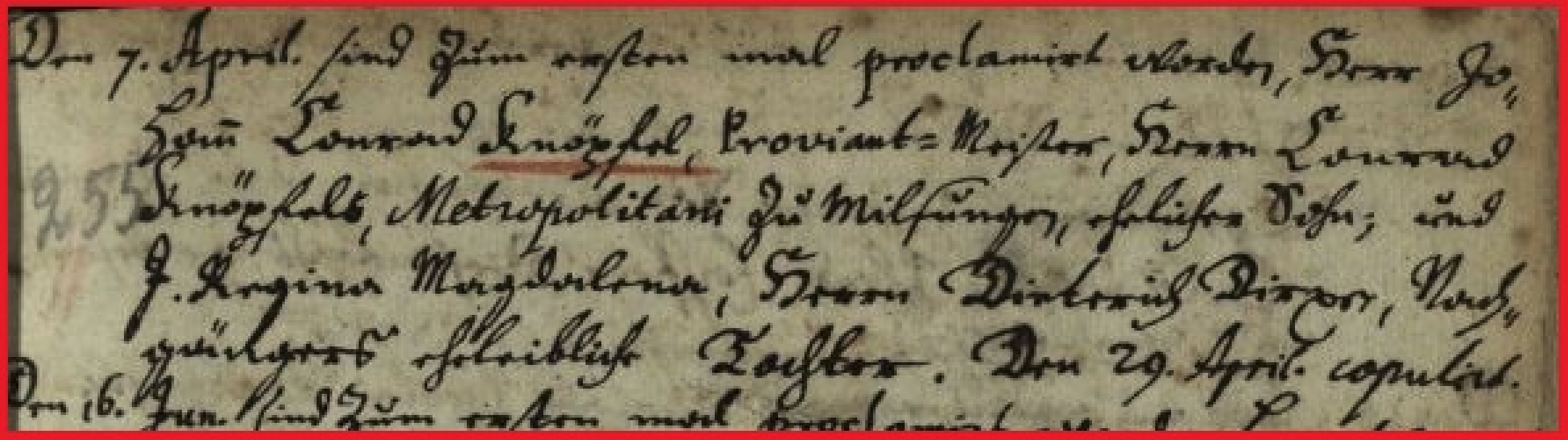
Den 7. April. sind zum ersten mal proclamirt worden, Herr Jo- han Conrad Knöpfel, Proviant=Meister, Herrn Conrad Knöpfels, Metropolitani zu Milsungen, ehelicher Sohn; und Jgfr. Regina Magdalena, Herrn Dieterich Diepers, Rath= gängers eheleibliche Tochter. Den 29. April. copulati. Den 16. Jun. sind zum ersten mal proclamirt.
On April 7th, the banns were published for the first time for: Mr. Johan Conrad Knöpfel, proviant master (commissary of supplies), legitimate son of Mr. Conrad Knöpfel, metropolitan (chief pastor/superintendent) in Melsungen; and maiden Regina Magdalena, legitimate daughter of Mr. Dieterich Dieper, town councillor. On April 29th, they were married.
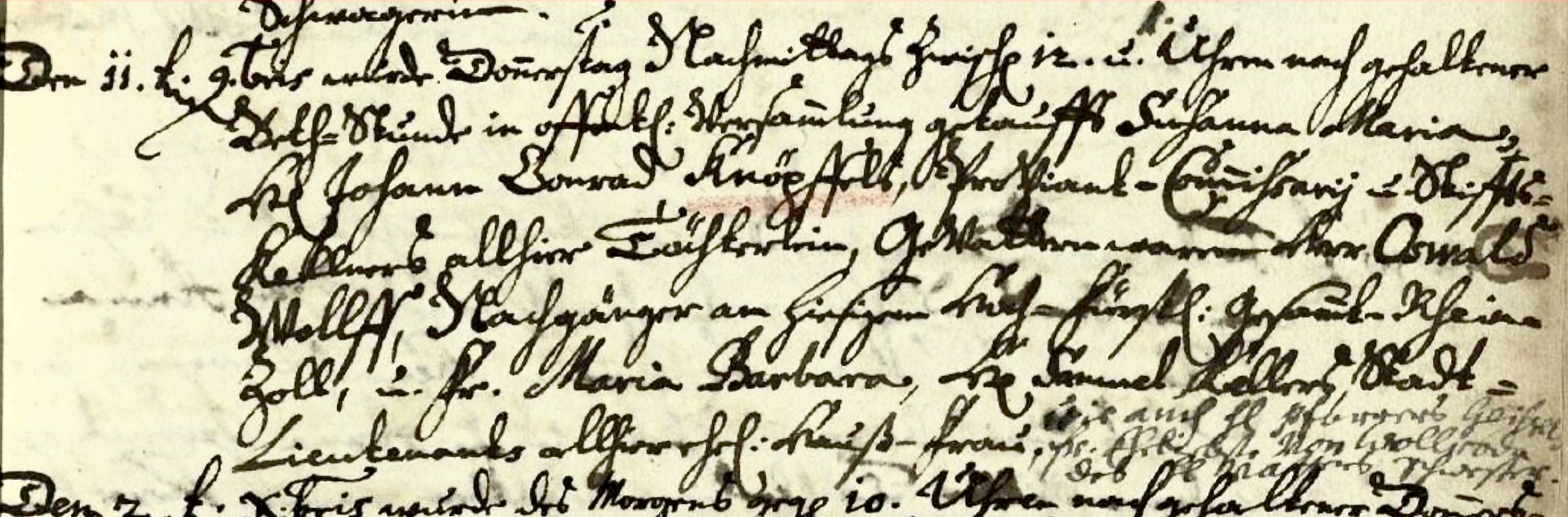
Taufeintrag Susanna Maria Knöpfel - transcriptie Dr. Johannes Burkardt
Complete
Den 11 t[en] [Novem]bris wurde Don[n]erstag Nachmittags zwisch[en] 12 u[nd] 1 Uhren
nach gehaltener
Beth=Stunde in öffentl[icher] Versam[m]lung getaufft Susanna Maria,
H[errn] Johann Conrad Knöpffels, Proviant-Com[m]issarii u[nd] Stiffts=
Kellners allhier Töchterlein. Gevattern waren Herr Oswald
Wollff, Nachgänger am hiesigen Hoch=Fürstl[ichen] Gesam[m]t-Rhein=
Zoll, u[nd] Fr[au] Maria Barbara, H[errn] Samuel Kellers, Stadt=
Lieutenants allhier ehel[iche] Hauß-Frau, wie auch H[errn] Pfarrers Geissel
Fr[au] Eheliebste von Wollroda
des H[errn] Vatters Schwester.*
* Die letzten 12 Wörter mit blasserer Tinte später nachgetragen.
Historical Reconstruction: The Living Environment and Social Transition of Susanna Knöpffel
Introduction
The youth of Susanna Knöpffel unfolded within the administrative and religious core of Sankt Goar. Her father, Johann Conrad Knöpffel, held two influential government posts: Stift-Kellner (chief administrator) of the chapter and Proviant-Commissair at the Rheinfels Castle. Consequently, the family belonged to the local governing elite.
Housing and the Stiftskellerei
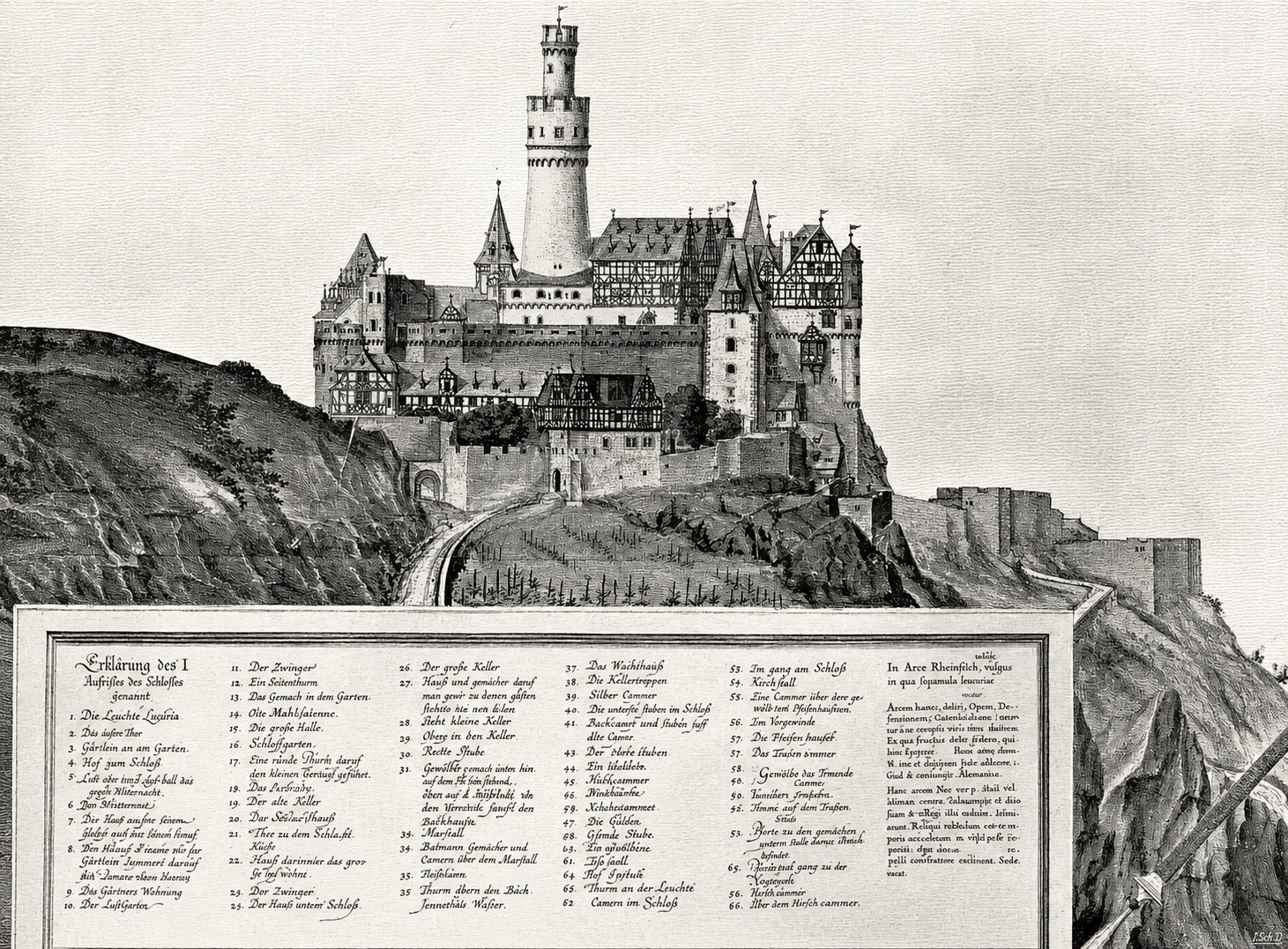
As chief administrator, her father was responsible for tax collection, lease revenues, and the church's real estate. The official residence and office (the Stiftskellerei) were located directly within the complex. Historical maps indicate that the family resided in the buildings directly adjacent to the church, designated as the Clofter (Cloister) or Aptey (Abbey). This was not a quiet private sphere, but rather a functional administrative hub. There was a constant influx of farmers, merchants, and officials arriving to deliver tithes in kind, such as wine and grain.
Logistics and Infrastructure Surrounding the Home
The daily routine of the family was logistically shaped by the surrounding infrastructure. To the north, the Obere-Straße served as the town's primary thoroughfare for transport and travelers. The Heiligen Gasse on the western side bordered the cloister complex, providing a direct and quieter route toward the market and the Rathhauss (Town Hall) in the lower town. The Wacher (the town brook) ran directly alongside the abbey, serving the complex's water supply and drainage needs.
Religious and Social Obligations
The Grose Kirch. (the Protestant Evangelische Stiftskirche) stood at the center of the family's public life. Due to her father's high social standing, the family held a permanent, respected place within the church nave. They attended all official Protestant services and ceremonies. This weekly attendance defined Susanna's social interactions within the upper bourgeoisie of Sankt Goar.
The Relationship with Rheinfels Castle
Although the family's administrative base was located in the lower town, there was a direct functional link to the military leadership. The Alte Burg and the higher-situated fortress of Rheinfels were the sites where her father managed military provisions. This meant the Knöpffel family maintained close ties with both the ecclesiastical and military authorities of the Landgraviate of Hessen-Kassel. Within this strictly organized administrative network, Susanna spent her formative years.
🇩🇪🇬🇧
Hessisches Landesarchiv complete files
Uffßner
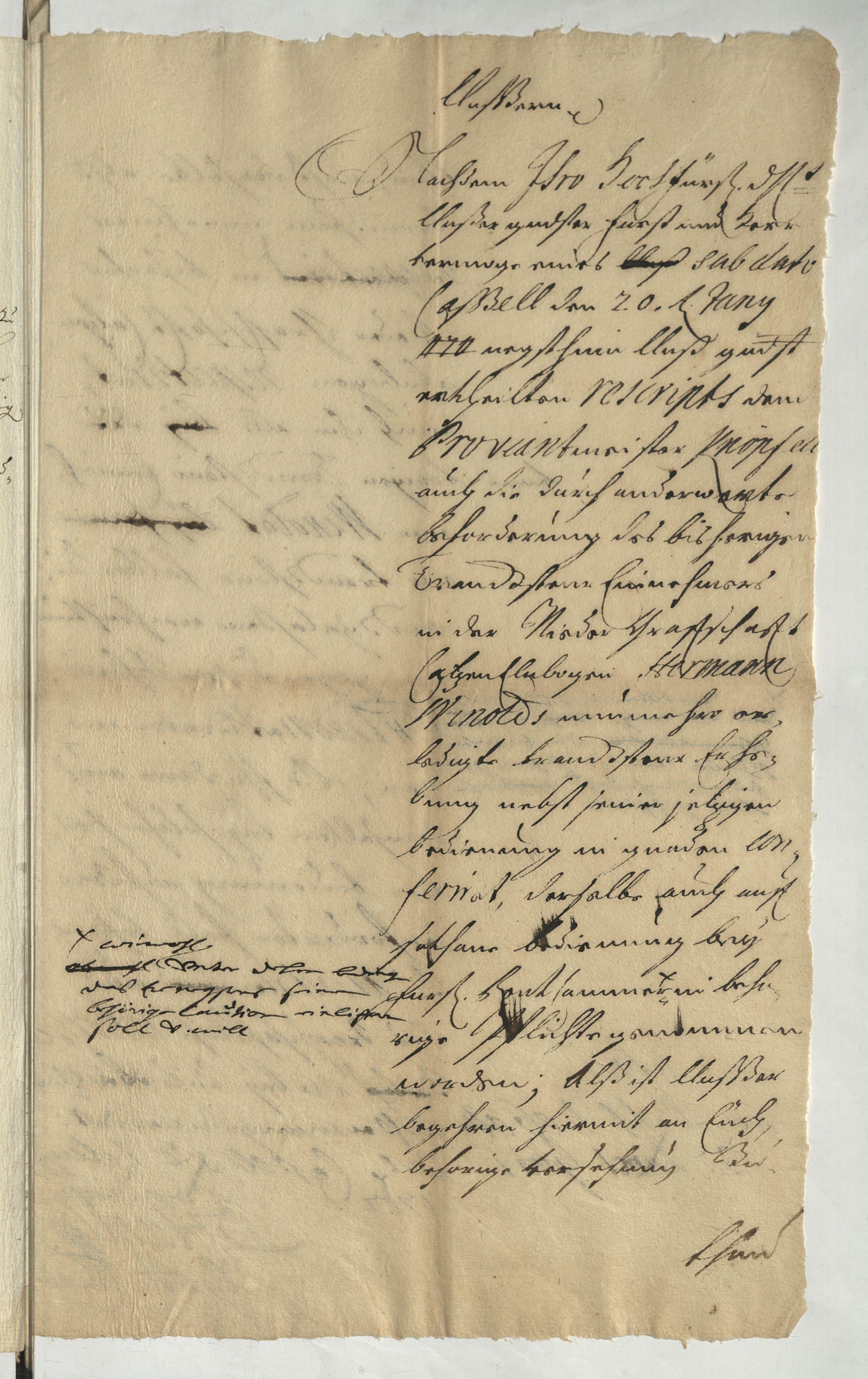
Nachdem Ihro Hochfürstl[iche] D[urchlaucht] unser gnädigster Fürst und Herr demwege mittels unterm Sub dato Cassel den 20.t[en] Jany 1707 ausgegangenen gnädigsten ertheilten Rescripts dem Proviantmeister Knöpfel auf die durch anderweite Beförderung des bisherigen Brandsteuer-Einnehmers in der Nieder Grafschaft Catzenelnbogen Hermann Winolds erledigte Brandsteuer-Ein- hebung nebst seiner vorigen Bedienung in gnaden con- feriret, derselbe auch auf solche seine Bedienung bey hies[iger] Land-Cammerey be- sugt Pflicht genommen worden; Als ist Uffßnern begehren hiermit an Euch gehörige Verfügung zu
(Marge aan de linkerzijde:) x worauf er erst vor alles das Cassa-Geld gehörige Caution einlegen soll &c. will
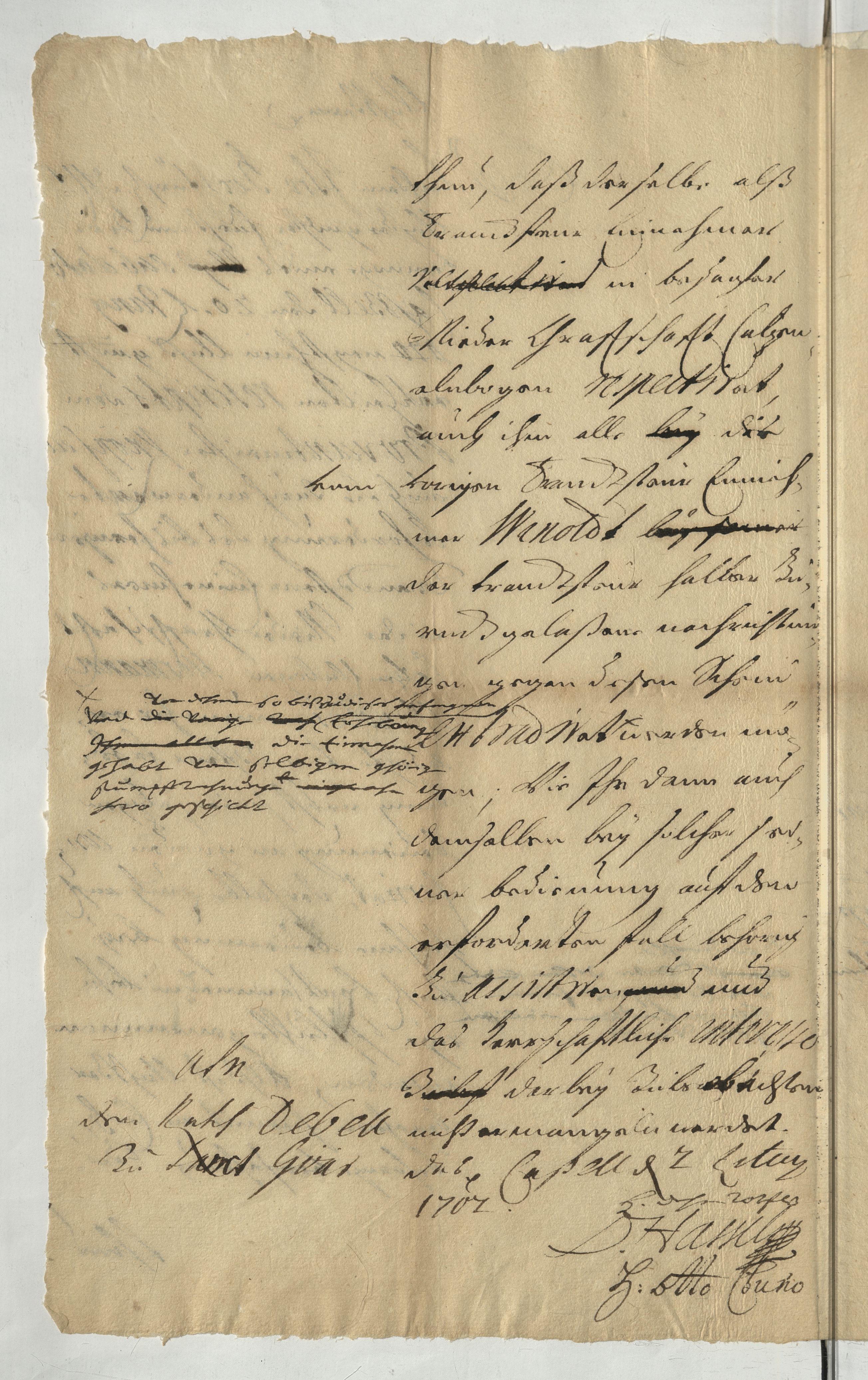
thun, daß derselbe als Brandsteuer Einnehmer im Cammertheil in besagter Nieder Grafschaft Catzen- elnbogen respectivè auch ihm alle bey des umrigon Brandsteuer Einneh- mer Winolds bisherigem derer Brandsteuer-Haltern be- eingelassene verrestiren- den gegen dessen Scheyn und Quittung abführen müssen, Wie Ihr dann auch denselben bey solcher sei- ner Bedienung auf den erfordernden Fall besördr[ig] zu assistiren, und das Herrschaftliche Interesse sowohl darby als übrigens nicht verfehlen werdet.
Dat[um] Cassell d. 2t[en] Febr[uarii] 1707
D. HAML... (Handtekening) G. Otto Cuno (Handtekening)
(Marge aan de linkerzijde:) x Von dem so bißherigen Einnehmer Weil die Cassa-Taxation worauf Ihm allen die Einnahme gehabt die selbigen gehörig Einnahm-Rechnung abgelegt pro 1707
von dem Rath Debell Zu Drots Güter
🇬🇧
Uffßner, Whereas His Serene Highness, our most gracious prince and lord, by a rescript issued under the date of Kassel, January 20, 1707, has conferred the collection of the fire tax in the Lower County of Katzenelnbogen—vacated by the transfer of the previous collector, Hermann Winold—alongside his previous duties, upon Provision Master Knöpfel, and he has taken the required oath for this office before the local land chamber;
You, Uffßner, are hereby requested to make the necessary arrangements so that all remaining outstanding fire tax arrears accrued under the previous collector Winold are paid over to him as fire tax collector in the said Lower County of Katzenelnbogen against his receipt and discharge. Furthermore, you are to assist him in the execution of his duties whenever required and ensure that the sovereign's interests are not neglected in this or any other respect.
Dated at Kassel, February 2, 1707.
(Margin notes): x Whereupon he must first deposit a proper security bond for all the cash funds, etc. x From the previous collector, as the treasury assessment to which all revenue belongs has submitted the relevant accounting statement for 1707. From Councillor Debell regarding Drot's estates.
🇬🇧
Tracing the Provision Master: How a 1707 Archive Document Unlocks the World of the Dülckens
A yellowed sheet of paper from the Hessen-Kassel archives, dated February 2, 1707, might seem like a dry administrative notice at first glance. Yet, reading between the ornate loops of the Kurrent script reveals a pivotal source for the historical network surrounding the famous Dülcken family of harpsichord makers.
The rescript issued from Kassel records an important decision by the Landgrave: Johann Conrad Knöpfel, Provision Master at the formidable fortress of Burg Rheinfels near Sankt Goar, is appointed to a major civic role. He becomes the new Brandsteuer-Einnehmer (fire tax collector) for the entire Lower County of Katzenelnbogen. Before assuming his duties, he was required to lodge a security bond for the cash funds with the land chamber and take the official oath—a clear testament to the Landgrave's trust in his financial governance.
A Regional Network Across the Rhine The geographic reach of this office is particularly revealing. The Lower County of Katzenelnbogen extended across both banks of the Rhine. Consequently, operating from Sankt Goar, Johann Conrad Knöpfel was responsible not only for the left bank but also for collecting taxes in the towns on the right bank—including neighboring Weisel.
In Weisel, Pastor Johan Jacob Schramm served as the spiritual leader of the Protestant community. As the regional tax receiver, Knöpfel was in regular contact with local town officials and clergy. It is all but certain that Knöpfel and Pastor Schramm were personally acquainted.
Tragedy and Legacy In Weisel, the lives of these families had already intersected in a deeply personal way. Father Georg Ludwig Dülcken was married there. Tragically, within a week of the wedding, their newborn son, named Johann Daniel, passed away. In accordance with the naming customs of the era, the name was passed on: the next son born to the family was likewise named Johann Daniel Dülcken.
This second Johann Daniel would grow up to become one of the most celebrated harpsichord builders of the eighteenth century. The circle between Rheinfels, Sankt Goar, and Weisel was completed when this brilliant young instrument maker married Susanne Maria Knöpfel—the daughter of none other than Provision Master and tax collector Johann Conrad Knöpfel.
The 1707 document is therefore far more than a routine administrative record. It provides concrete evidence of the social, geographic, and financial foundation that supported the Dülcken family's network along the Rhine, setting the stage for one of history's greatest instrument-making legacies.
🇬🇧
Supplementary Note: Who Was Uffßner?
To fully appreciate the administrative mechanics of the decree dated February 2, 1707, one must examine the official to whom it was addressed: Uffßner.
Uffßner served as the landgravial Amtmann (magistrate or chief bailiff) of the local administrative district (Cammertheil) within the Lower County of Katzenelnbogen. In the governance structure of Hessen-Kassel, the Amtmann occupied a vital position, executing directives issued by the central court in Kassel. The decree explicitly tasks him with overseeing the transition on the ground:
Managing the Handover: Uffßner was instructed to organize the official transfer of responsibility from the outgoing tax collector, Hermann Winold, to the newly appointed Provision Master, Johann Conrad Knöpfel.
Financial Oversight: He was responsible for ensuring that all outstanding fire tax arrears were systematically paid over to Knöpfel. Furthermore, Uffßner had to verify that Knöpfel deposited the required security bond (Caution) with the land chamber before taking custody of the public funds.
de voor de vlekkeloze werking van het financiële netwerk tussen het hof in Kassel, de vesting Burg Rheinfels en de omliggende Rijndorpen zoals Weisel.
1.
Heirat von Conrad Knöpfel und Regina Magdalena Dirx am 29. April 1695 (KB 149/1, S. 255);
2.
Taufe von Dietrich Conrad Knöpffel am 9. Februar 1696 (KB 149/1, S. 105);
3.
Taufe von Maria Sophia Christiana Knöpfel am 9. November 1697 (KB 149/1, S. 116);
4.
Taufe von Anna Margaretha Elisabeth Knöpffel am 24. September 1699 (KB 149/1, S. 125);
5.
Taufe der am 18. April 1701 geborenen Anna Getrud Henriette Knöpfel (KB 149/1, S. 130);
6.
Taufe von Johann Christian Ludwig Knöpffel am 21. Juni 1703 (KB 149/1, S. 137);
7.
Taufe von Johann Henrich Werner Knöpffel am 23. Dezember 1704 (KB 149/1, S. 142);
8.
Taufe der am 16. Mai 1709 geborenen Anna Christina Dorothea Knöpfel (KB 149/1, S. 158);
9.
Taufe der am 28. Februar 1711 geborenen Maria Elisabeth Knöpffel (KB 149/1, S. 162);
10.
Taufe von Johann Ludwig Knöpffel am 29. Dezember 1712 (KB 149/1, S. 168);
11.
Taufe des am 22. November 1714 geborenen Johann Wollrath Knöpfel (KB 149/1, S. 177).